

CRACKER
The real reason why so many undergraduates are studying Psychology

By today’s multi-digit standards, it was tiny. The show was barely there. Cracker lasted just two years and clocked a meagre total of twenty-five episodes. Yet rarely has fiction had such an impact on the real world, this side of the screen. Let me explain.
What was Cracker about? It featured a maverick psychologist who – get this - helped the police solve baffling crimes. Who could resist such a crazy, madcap idea? ‘Judging by the first episode, the title is spot-on.’ So said the only review I saw. Naturally, I tuned in. So did everyone else: town centres stopped when Cracker came on. It could bring in 15 million viewers at a time. This was the nineties, after all, and there was nothing else to do.
When Cracker first aired, Psychology was still a bit of a public mystery. You knew far more undergraduates who were taking English or Art History. ‘Why not study Psychology?’ one Times columnist reported advising her nieces. ‘Be different.’ Those nieces wouldn’t be different for long. By the time first series ended, Psychology departments across the country had moved to bigger premises. Exact figures seem impossible to obtain (I’ve tried) but academics everywhere agree: Something happened. Television distorted life and life responded by saying ‘Let’s have some more of that’.
Among an older generation of British psychologists, the ‘Cracker effect’ remains a byword. ‘Maverick psychologist’? The very phrase had a beckoning, seductive ring, even as the strictures that governed psychologists in the real world grew tighter day by day. ‘Baffling crimes?’ cried the students, convinced they were the ones to solve them. ‘Sign us up!’
‘Gritty and realistic,’ said the critics, who probably reckoned they got street cred for thinking so. Everyone did. But, no, Cracker wasn’t realistic - not really. Even in that lost world of thirty years ago, you’d have struggled to find a real maverick psychologist anywhere. No one would employ them. And any police officer can tell you exactly how few ‘baffling’ crimes there really are.
Yet the dull realities counted for little against the lure of the box. Millions of square-eyed viewers were convinced that, for forty minutes a week, their telly transmogrified into a dark version of Disney’s magic mirror: Who was the foulest of them all? Cracker belonged to a specific tradition of story-telling: the more pessimistic your outlook, it insists, the more truthful you’re being. Misery equals verisimilitude and only a naïf would think otherwise.
Eager students formed orderly queues. Universities grabbed their fees faster than purse-snatchers in an alleyway, and then blandly mentioned that, before the baffling crimes started, everyone would have to study statistics for ten weeks. ‘It’ll be all baffling crimes after that, won’t it?’ the undergraduates asked, wide-eyed and hopeful. The answer was no (the real world had spoken). First one had to endure a joyless and lip-pursing course in research ethics. Students might be twenty weeks in before they got so much as a glimpse of another human being, let alone a baffled policeman. Many, lured away by neuroscience or developmental theory, forgot their original plans. Others figured their best chance of seeing the inside of a real cop-shop was to get nicked for joy-riding a motorised cart from the local golf course (but that’s enough about me).
MORE FROM CRIME & PSYCHOLOGY:
MEDIA VIOLENCE IS GOOD FOR YOU
TRUE CRIME BOOKS YOU SHOULD READ
Of course, students in the 2020s have never heard of Cracker – or if they have, they know it only from the dusty spines of their parents’ VHS collection, Robbie Coltrane’s frown simultaneously forbidding and approachable on the spines. (How did he do it?: He always looked like a nice fella who might want to kill you.)
Be that as it may, if Cracker had never appeared, most of today’s Psychology undergraduates would be surely taking some other course. The echo of an explosion continues long after the smoke has cleared. They didn’t call it Cracker for nothing.
You may be wondering: what is this Cracker, anyway?
Here are the basics: Robbie Coltrane plays a man who was known as Dr Edward Fitzgerald but only on Sundays. Even his wife calls him Fitz. The thing about Fitz is, he doesn’t. ‘I drink too much, I smoke too much, I gamble too much. I am too much,’ he proclaims. Such an outlandish character – such an obviously fictional one - could never prove a match for the mundane realities of adult life. The one time we see Fitz deliver a lecture, he throws all the textbooks at his students. (This is very unrealistic. Even I never went as far as that.)
Fitz, you see, does not understand himself, his life, his wife, or his son. He does not understand the world he inhabits. What he does understand (and, this being television, everyone agrees he’s ‘brilliant’) is absolutely everything about criminals and their victims. If no one can fuck up like Fitz, no one can console a grieving mother like him, either, let alone suss the motivations of a killer. Skilled at handling a vast array of tools, he simply can’t apply them in the one place they would do him good.
When people review Cracker today – and believe it or not, they still do – they seem compelled to comment on its age. ‘It’s hard to believe it was made in the nineties,’ they write. ‘It looks contemporary, modern, up to date.’
It doesn’t. Cracker looks like what it is: a show whose fourth decade is in sight. Something gives it away, and it’s not what you think. It’s not the mullets, the tracksuits, the audio cassettes, or the jam-sandwich police cars. It’s not the ‘discriminatory language’ of the sort you can still hear absolutely anywhere in the world except on telly. It’s not even the fogged-up, grainy, low-res picture, which, to be fair, may just have been a consequence of filming out of doors in Manchester.
You can tell Cracker was made in the nineties because it’s good.
And what’s good about it, exactly? I think it’s this: Cracker never tried to be anything but what it was – a downbeat sliver of nineties noir, presented without apology and disdainful of your own shocked reactions. There’s something quite exilerating about that.
Imagine the waiter plonking down some brussels sprouts and telling you this is a realistic diet. Man-of-the-people that you are, you feel compelled to tuck in. It’s the only realistic thing to do.
Cracker had no safe spaces. It recognised no triggers, traumas, or unintentional distress. It did not moralise. It did not tell you what to feel, or why, or for whom. It may not have been the highest art, but it had one quality in common with it: Cracker, (like brussels sprouts,) was just plain there. The same might be said of the actors, who did not turn up, so to speak, on your screen in quotas, each cast-member representing a specific demographic slice of the potential audience. You can almost imagine they were picked in accord with the unfashionable principle of merit.
You may never have visited Manchester, but, after a few episodes, you’ll feel as if you know its fictional self well. The real Manchester may not have been as grim as they made it out to be, but they sure made it out convincingly. Here’s what a suspect tells Fitz in episode 7 (Fitz has been considering adultery):
‘You’re a happily married man, are you? Hmm? […] You go on living your lie. You’re a hypocrite. To hell with the consequences, to hell with who gets hurt, just so long as you can expose lies. Not your own of course. Other people’s. That’s got nothing to do with truth. Just out of selfishness, you bloody hypocrite.’
In a post last year I argued that the Golden Age of Television had passed away peacefully after a brief convalescence. The Golden Age came and it went. We shall never see its like, etc. You could argue that it all began with greatest television show of all, Twin Peaks, and spooled on into The Sopranos, The Night Of, and Breaking Bad. All of these, of course, are American shows – a bit slick, a bit glittery, half a world away from Manchester. If the UK could contribute only one title to the list, many would nominate Cracker.
Let’s not get the impression that Cracker was perfect, or anything close. If it was often good, it was occasionally bad as well (it was not unlike its own protagonist). There was a lot to worry about in the show’s relentless portrayal of the worst, emptiest, and plain stupidest of human behaviour, not to mention its adolescent insistence that once you’d accounted for all that badness, emptiness, and stupidity, there was not much left in the world to think about. Imperfections are what make a show – or a person – interesting, of course.
We return to the question of influence: where it begins and ends. If movies and television have utterly changed the qualities of our inner lives, so that few of us can regularly resist the impulse to think of ourselves as the stars of our own shows, can we really be surprised by the youthful legions who were suddenly assuring their careers advisers, ‘Oh, I’ve always wanted to be a psychologist’? They’d always wanted it for at least six months.
If everyone wanted to be like Fitz, no one wanted to be Fitz, not in the way previous generations had once swamped Veterinary Medicine departments the world over because they wanted to be James Herriot. Overweight, bad-tempered, addicted to everything you could name, Fitz was no one’s aspiration.
Clearly something about him was appealing though and I think I know what it was: Something we touched on earlier – the apparent plainness of his approach, his take-it-or-leave it attitude, this-is-how-it-is. ‘Yes,’ one is tempted to think (if one hasn’t hit twenty yet,) ‘I know all of this and I can handle it. The world is a grim place for sure (especially the Manchester part of it) but to a graduate with a degree certificate and no illusions, nihilism holds little fear’.
Would you like to buy me a coffee? You can do it here.
Such an attitude is illusory of course. So is the belief that the real world is amok with hangings, suicides, rapes, and murder plots. For sure, nasty things do happen, but they are far rarer than Cracker would have you believe. If the world of Cracker were the real world, as opposed to the merely realistic one, no one would survive till tea-time. We’d all be corpses hanging from suburban trees.
Cracker ran for three series and two specials. An American version ran for sixteen episodes. Strangely, it was set in Los Angeles – great for films noir, but rather a sunlit substitute for Manchester, you’d have thought. Detroit or Philadelphia might have fit the tone better. The American version was imported back to the UK and renamed Fitz. Robbie Coltrane himself was a guest star. He was taking time off from winning three consecutive BAFTAs and an OBE. He died in 2022. I used to live downstairs from his mother and sometimes passed him on the steps, a slow locomotive of a man huffing his way up to her door.
Crime & Psychology: it’s all killer, no filler. Click a blue button below to show you agree.
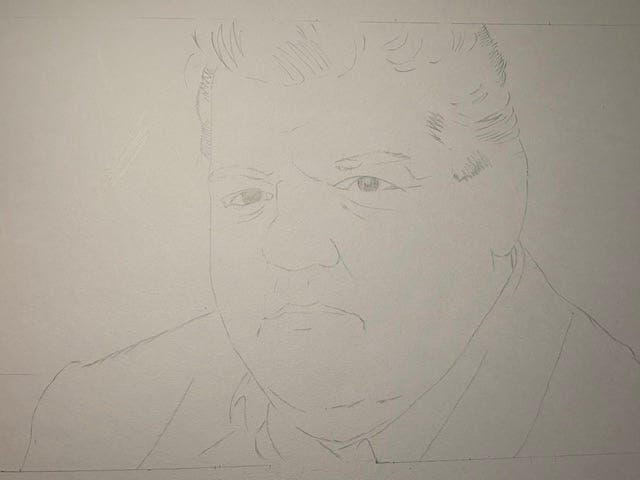
Second-rate drawing of Robbie Coltrane by the author.
Love this piece, but did not love Cracker! My mum was a huge fan. It was a very different sort of character, the sort the Brits do best I think - the US Fitz crossover bit sounds a bit of a mess to me and I'd never heard of it. Lovely little fun fact of Mrs Coltrane upstairs too.
My own fun fact: My niece studied Criminal Psychology, got a Masters too...could be a niece thing... I'll ask her if she's heard of Cracker :-)
I love this show. I never heard of it until more recently, as a typical American whose awareness of what is going on in other countries is thin at best. I struggle even to understand what is going on in my own country.
My lack of awareness of the stench of phone boxes apparently contributed to my enjoyment.
And I find that I am curious about your run-in with the law. I’ve always envied people who find joy in a joy ride; for me, it’s a peck of fun to sit in one place while others ride the gas pedal and commit baffling crimes.